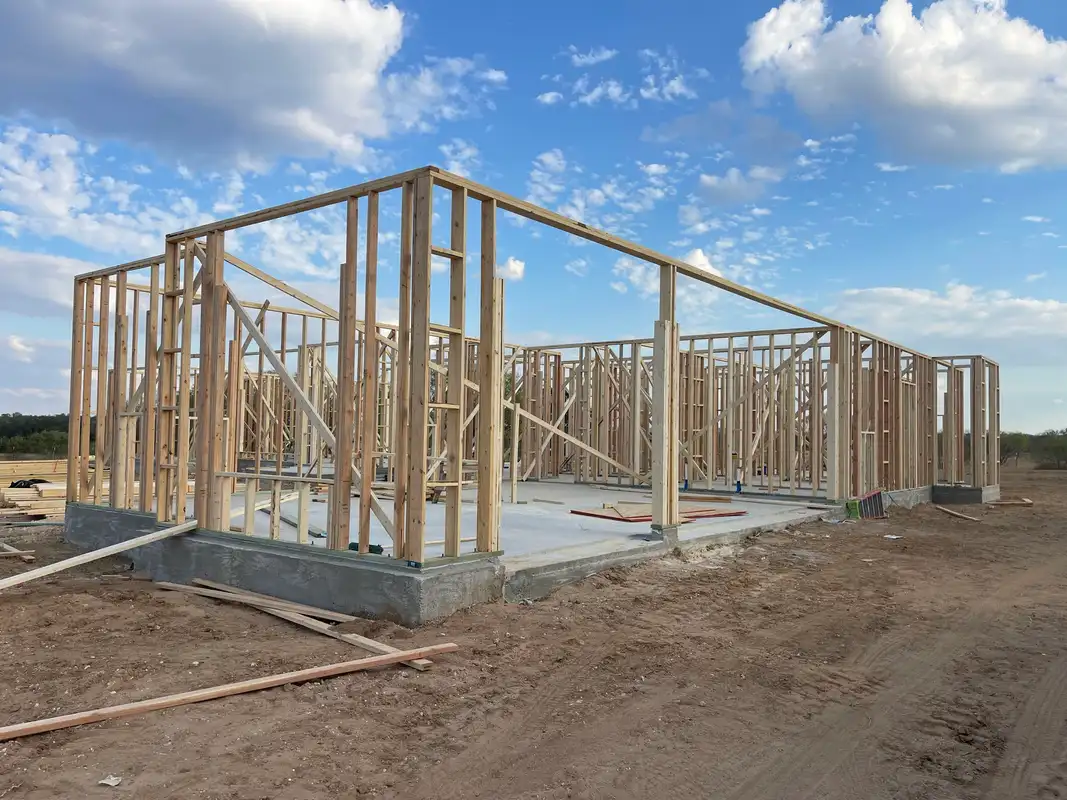
Code allows 24" on-center framing for exterior walls and most interior walls in Texas. Most production builders use 24" because it saves lumber and labor — roughly 30% fewer studs.
We frame at 16" on-center. Every exterior wall. Every interior wall that carries tile. Here's why.
What "On-Center" Actually Means
"16" on-center" means there's 14.5 inches of space between each stud (the stud itself is 1.5" wide). "24" on-center" means 22.5 inches between studs. That 8-inch difference doesn't sound like much — until you live in the house for 15 years.
Three Things 16" Framing Gets You
1. Solider Walls
More studs means less flex. You can feel the difference when you lean against a wall or close a door. A 24" framed wall has more bounce. A 16" framed wall is solid. That solidity also means less drywall cracking over time as the house settles.
2. Better Tile — For Decades
Porcelain tile is rigid. The substrate underneath it needs to be rigid too. A 24" framed wall flexes more under load, and flexing is the #1 cause of cracked tile and grout lines. At 16", the wall barely moves. Your tile stays flat and intact.
This is why we frame every bathroom, kitchen backsplash, and shower wall at 16" — even where code says 24" is fine.
3. More Insulation, Better Efficiency
More stud bays means more room for insulation. The difference is modest per bay, but across every exterior wall in the house, it adds up to noticeably better thermal performance.
Why Most Builders Don't Do This
It costs more. About $2,000–$4,000 more per house depending on size. That's real money. But compare that to the cost of retiling a shower in year 8 because the wall flexed, or fixing drywall cracks every 3 years. The math works out — if you plan to own the home for more than a minute.
The Bottom Line
16" framing is one of those "built once, built right" decisions. You'll never see it. But 10 years from now, you'll hear it every time you close a door and the house doesn't shudder.